Menu

Skip to content
Gaming Pathology

Gaming Pathology

Piles Of Games, Copious Free Time, No Standards

Off-Brand Hunchback

Posted on November 19, 2007 by Multimedia Mike

I have been trying to play some games recently but I have been discouraged by the creeping, non-fun sensation I get when I realize that I’m duty-bound to do a bunch of writing afterwards. That’s right, I seem to have finally hit that wall where playing these games is no longer any fun. Still, I have a goal of hitting 10K MobyGames contribution points before the year is out. And at this point in the experiment, you had better believe I understand the most efficient way to get mucho points off of a single game — by exploiting any given Macromedia Director-based game. Why? For these reasons:

  • They are often spec’d to run on 2, sometimes 3 platforms (Windows 95, Mac, and sometimes Windows 3.x).
  • I usually have a full cover art set of 3-5 scans.
  • The games are easy to blow through in a 1/2 hour and I can get a complete description of the game and a diverse set of unique screenshots, usually 20-30.
  • These games nearly always neatly roll their credits. Enter them for one platform. Once approved, easily copy & paste them for the other platforms.
  • These games are often produced by obscure, one-hit wonder-type companies that only ever produced a game or 2 before learning the hard way that the road to riches isn’t paved with cheap CD-ROM entertainment. The companies often aren’t in the database yet for this reason.

For all of these reasons, Babes in Toyland recently netted me well in excess of 100 contribution points.

With that, allow me to present the Director-based game, Hunchback of Notre Dame.
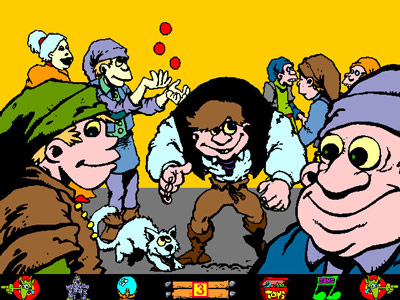

Hunchback on Notre Dame — Quasimodo in a page from the interactive storybook

Published in 1996, this title is not based on Disney’s movie from that same year. Indeed, today’s specimen might be termed in some circles as a knock-off, but is it really? Disney does not actually have exclusive rights to the Hunchback story, only certain characteristics unique to their telling.

Anyway, this game consists of 4 minigames — rather abysmal minigames, I should note — based around the artwork shown in the story. The main attraction is the interactive storybook. Pages are shown as above. A text overlay is shown onscreen with part of the story. A narrator reads the text while segments are highlighted so that the user (presumably a young child who is disappointed that this game is not based on the real deal from Disney) can follow along. There is also a produced song that the user can opt to listen to. It comes off as something from an easy-listening radio station. I suppose it could very well have been the lead radio single from the Disney Hunchback.

This is one of the minigames, Make-A-Match:
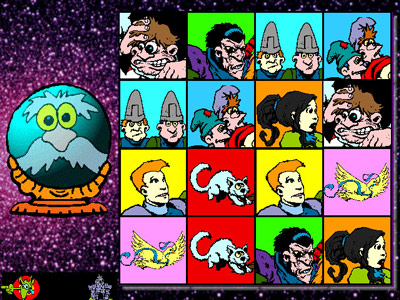

Hunchback on Notre Dame — Make-A-Match memory game

You recognize the concept– the card-matching memory game. This variation is unique in that it gives the player as much time as desired to study the board before covering it up with rocks. Another game called Ring The Bell is yet another memory game where the player must remember and replay and sequence of bell tones.

This was the worst game for play control reasons:
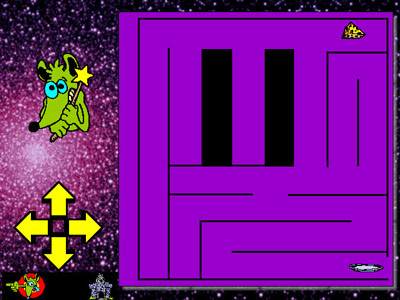

Hunchback on Notre Dame — Rat Maze game

It is called Rat Maze and what makes it so bad is that you have to click on the arrows on the left in order to move the cheese. The problem is that the underlying input mechanism wasn’t programmed in a very future-proof manner and even the speediest mouse click will send the cheese bolting to the opposite end of the maze.

This last item counts more as an ‘activity’ than a ‘game’ — Gargoyle Builder. Build your very own gargoyle from various colored body, arm, and head styles. Then you can press the ‘dance’ button to make him, well, spasm uncontrollably:
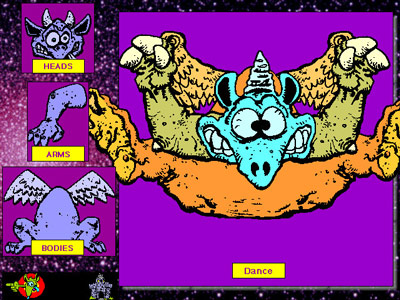

Hunchback on Notre Dame — Gargoyle Builder game

I admit that I have not read the original Hunchback tale (I didn’t even sit through all the pages in this animated storybook), though I did see Disney’s 1996 film (which, as an unabashed fan of 1990s animated Disney fare, I thought was an extraordinarily mediocre effort, save for the soundtrack). I did a text search for the word ‘gargoyle’ in Wikipedia’s entry for the story and came up empty-handed. Could it be that this game was brazenly ripping off that aspect of Disney’s creative license? Perhaps the people who developed this game didn’t read the original story either, but just saw the Friday premiere of the 1996 film and worked all through the weekend on this treatment.

This all reminds me of an old Suck.com essay called Faux Film Festival:

It’s a familiar, horrifying scenario. An exhausted parent in a video store or supermarket sees a videotape packaged for sale. The tape boasts a familiar title — Aladdin or The Hunchback of Notre Dame — and an attractive sticker price. Upon arriving home, the tape is proffered to media-savvy children, who immediately proclaim, in loud, whiny voices, “This isn’t the real Aladdin.”

The article notes that Disney lost a lawsuit to try to block such knock-offs. This might help to explain why, in recent years, they seem to have moved away from adapting traditional (read: public domain) stories (the last I can recall is 1999’s Tarzan) and more towards new properties (like The Emperor’s New Groove and Lilo & Stitch).

What floors me the most about this game is that the guilty parties still seem to be in business: Peter Pan Industries, the publisher, is still around and is still ripping off everything Disney does. Amazing. Check out their catalog. They have, not one, but three episodes of The Little Cars (see Disney’s Cars). There is also Ratatoing, which I strongly suspect is influenced by Disney’s Ratatouille.

The game was developed by Right Angle, Inc. who has a portfolio to show for their 14 years in operation. This game, however, is not showcased.

At MobyGames:

  • Hunchback of Notre Dame

See Also:

  • Hunchback of Notre Dame Archived at Internet Archive
Posted in Childrens Games Mac Games Windows Games | Tagged hunchback of notre dame | Leave a comment

Missing Games — The Incomplete Lists

Posted on November 10, 2007 by Multimedia Mike

This blog has been a bit stagnant lately, but that’s not because of a lack of material yet to be entered into MobyGames. Indeed, the more data I enter into the database, the more data I somehow come across that yet needs to be entered. In fact, over the course of this experiment, I have created a number of lists of all the games that I personally know of that are not in the database.

Thus, I present to you the lists of missing games. My personal specialty is 8-bit NES games. As of this writing, there are still about 85 NES games missing from the database. Not bad, considering that the number was over 250 when I first started contributing a few years ago. For certain lists like the NES and Dreamcast lists, I sought out official or unofficial game list compilations and carefully reconciled them against MobyGames. For lists such as Windows and Sony PlayStation, I have not done a formal reconciliation process yet and have only been compiling lists as I become aware of games that are not in the database. This usually occurs when I am browsing eBay stores that stock lots of obscure gaming software.

I have been working a lot on my primary technical blog recently (which sometimes involves some game hacking). But I would still like to return to this effort because I want to score 10,000 MobyGames contribution points before the year is out. Right now, I have a little over 8700 points. It should be a doable goal.

Posted in The Big Picture | Tagged mobygames | Leave a comment

More Pizza Hits

Posted on November 2, 2007 by Multimedia Mike

Rejoice! Someone else has actually played this game! Karen came along and made a request for another smash hit track from the Little Caesar’s Fractions Pizza, and I’m only too happy to indulge her nostalgia. This one deals with how whole numbers can be divided and united.


Apple iTunes AAC file
Little Caesars Fractions Pizza — The Whole Can Be Divided Or United, 1.31 MB, MPEG-4 AAC (.m4a) file

Who knows? Maybe I will start posting much more music from forgotten video games — until an IP owner complains about it — just to make effective use of my web hosting plan.

Posted in The Big Picture | Tagged fractions game music little caesars pizza | Leave a comment

First PS2 Games

Posted on October 21, 2007 by Multimedia Mike

The Sony PlayStation 2 is nearly 7 years old. Yet today was the first time I actually sat down and played an actual PS2 game. I got this PS2 unit some months ago, mostly for DVD playback. I have tried out a few PlayStation 1 titles on it. But I also have 3 PS2 games laying around.

The first one is called Evergrace, from the confusingly named FromSoftware. Apparently, this was a PS2 launch title. I purchased it while procuring a bunch of other cheap, old games from an eBay seller. Even though it was already in MobyGames (sans screenshots), it was cheap and in new condition, and I thought it might be nice to try a real PS2 game, and an RPG at that. I was disappointed. First, I tried to dutifully digest the manual before delving in since RPGs can be complicated. I have to pinch myself to keep from falling asleep since the manual goes into so much storyline. I skim the section on the controls and figure that they’ll make more sense in context, so I fire the game up. The first order of business is to check my speakers to see if anything is wrong. Nope– the music really is that cacophonic. Then the game assaults me with the same storyline I didn’t care about from the manual.

Eventually, the game gets rolling and you essentially have 2 characters to choose from — a guy and a girl — who will follow different paths in the game. Evergrace bills itself as an action RPG with an emphasis on equipment. I guess I’m supposed to kill creatures, get currency, exchange it for goods, and kill more creatures. I found the store, found out I was broke, went outside and tried to kill something, and learned that I was fairly ineffective in this task when using only my bare hands. I got bored of this quickly though I tried to give the game a fair shake. I even went back to the insomnia-curing manual a few times but couldn’t maintain the motivation.

The next title, Orphen: Scion of Sorcery, was also a launch title. I’m beginning to think that early adopters were awfully forgiving. I know these kind of graphics reigned supreme at one point but they seem fairly ho-hum these days. There is also the fact that for the past 7 years, I have largely been examining magazine and internet screenshots of PS2 games rather than seeing the actual games in action, which tends to elicit a far different reaction.

Anyway, Orphen— I had never looked too carefully at the literature for this one. I had always assumed it was an action game where the hero fired magic bullets. While that’s part of it, the game turns out to be of the genre action-RPG. RPGs really left me behind somewhere along the line. Mostly, I am used to the classic NES turn-based stylings of the original Final Fantasy game, the Ultima: Exodus port, and the classic Dragon Warrior series. The principle action in Orphen consists of encounters where characters square off with a number of enemies and quickly attack using offensive magic spells or magic weapons, or parry attacks with a magic shield. It’s RPG-ish, in a fast-paced way.

There is also some kind of storyline tying this all together. Based on the opening scenes, it was pretty obvious that Orphen must be based on an anime series, and sure enough. I’m not especially fond of anime to begin with and this game’s characters seem to embody much of what I despise. Still, I gave it the old college try. It’s a tad slow-going as you walk a few meters, run into a pre-scripted story advancement sequence, walk a few more meters, get more story, an enemy encounter, and then repeat. Apparently, that’s the whole game. The game’s copy lists as one of its key features “51 action-packed, event-based encounters.” I got through 5, maybe 6 of them, depending on how score is kept.

Finally, I decided to actually play a dreaded sports game– NHL Hitz 20-02. Generally, if I wind up with a sports game in my collection, it’s because A) it was dirt cheap, and B) because I wanted to study its multimedia files. This game served its purpose to that latter end. But how does the game play? The Hitz series is apparently a totally X-treme hockey experience based on licensed NHL teams. “No rules” is the overriding theme. The game assaults your auditory senses with Limp Bizkit in the opening FMV. Then there is quite a variety of activities available. Not only actual hockey, but violent minigames, such as body checking a number of players within a set time limit.

When I finally set up a screen capture process for my PS2 and Saturn games, at least I will know exactly what to capture for these 3 titles and be done with them.

See also:

  • Adventure in Toledo: Followup entry on Evergrace
  • Orphen Redux
Posted in Action Games PlayStation 2 Games RPG Games Sports Games | Tagged evergrace limp bizkit mobygames nhl hitz orphen playstation 2 ps2 rpg | 5 Comments

Quattro Arcade

Posted on October 21, 2007 by Multimedia Mike

This past week, the company cafeteria was serving a dish labeled “baked penne pasta with quatro formagio”. It certainly sounds like an authentico Italiano experience, until one recalls that “quatro formagio” just means “4 cheese”. For some reason, though, seeing the dish reminded me of an NES game yet to be played and entered into the database— an unlicensed Codemasters cartridge called Quattro Arcade. Codemasters actually put out a bunch of these Quattro game quartets for various old time systems. In fact, Quattro Arcade is already in the database so I thought this would be a straightforward screenshot recon exercise. No such luck as the NES version has 4 completely different games.

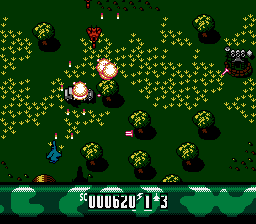
The quality of these old, unlicensed NES games is generally nothing to write home about, so I can’t say I’m excited about this experience. However, Codemasters is unique in the sense that they have endured to this day and are still putting out titles. And there is at least one game of the four that I really get into: F-16 Renegade:


Quattro Arcade -- F16 Renegade, overhead portion

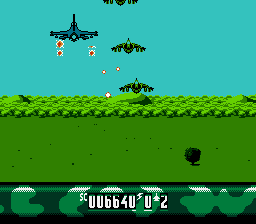
The manual for Quattro Arcade is available online. Wouldn’t you know, the authors saw fit to craft long-winded backstories for each of the 4 games. Look, F-16 Renegade is simply a fun, straightforward, curiously devoid of music, shoot-em-up game that alternates between overhead levels, as seen above, and third person behind-the-plane levels:


Quattro Arcade -- F16 Renegade, third-person view

All normal-looking planes (in the air) and normal tanks and missile batteries on the ground. There are powerups that enhance your offensive capability. The curious aspect of this is that the powerups carry over between the 2 different types of levels. And while one strike does your plane in, you only drop one power level when you get your next plane, instead of losing all of your firepower.

I made it to level 6 in this game. I am not sure how many levels there are, but level 4 was called “Rating… talented amateur”. So I suspect the game continues for some time.

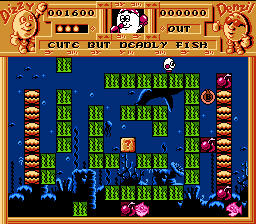
There is a Dizzy title in this set. Dizzy seems to be a mainstay in Codemasters’ early IP repertoire. The game in this set, Go! Dizzy Go! struck me as sort of a bastard stepchild of Pac-Man.


Quattro Arcade -- Go! Dizzy Go!

On each map, collect all the fruit. Avoid the threats that are marching about, whatever they may be on this round. I can’t get past the idea of seahorses being a threat, but that’s just me. You can also push around columns of blocks. Okay, maybe it’s a little more reminiscent of a block-based puzzle game, e.g., a Lolo title.

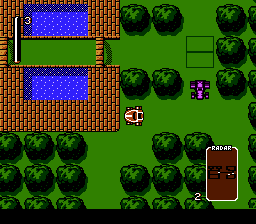
Next up is Stunt Buggies. Drive around in an overhead perspective and collect bombs while enemy buggies work desperately to stop you. You can slow down enemy buggies, apparently by leaving some exhaust.


Quattro Arcade -- Stunt Buggies

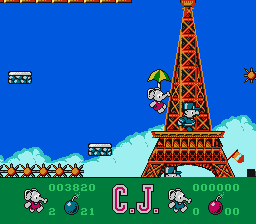
The final game in the quartet is C.J.’s Elephant Antics. The game actually starts in Paris:


Quattro Arcade -- CJ's Elephant Antics, Eiffel Tower action

It’s a side-scrolling game. C.J. must make his way home to Africa, according to the manual. He has an umbrella to slow descents. He can fire peanuts. Also, he can drop bombs. Until that last item, this seemed like an all-too-delightful kids game.

Posted in Action Games NES Games | Leave a comment

Golf Curse

Posted on October 5, 2007 by Multimedia Mike

Another batch of budget bilge ordered from eBay arrived today. My customary first title of the group is Minigolf: The Game … maybe. It might be Minigolf 2003. Or perhaps just Golf 2003. It depends on which of the 5 companies involved with this game that you ask. This is the kind of game that really causes headaches when it comes to logging its data into MobyGames. As stated, the game mentions no fewer than 5 companies between the packaging and the in-game screens. Further, it contains 3 copyright dates depending on where you look as well as 3 different titles. Which takes precedent?

I am guessing that this game was developed by a non-English-speaking development house, as evidenced by the instructions screen. A portion is shown below and illustrates how the title for the post is derived:


Minigolf -- Poorly spelled instructions

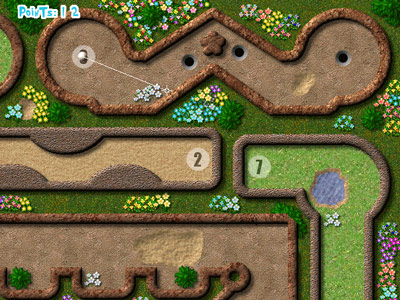
Right off the bat, it’s fair to say that I prefer those 3D Ultra Mini Golf Adventures games from Taco Bell. This Macromedia Director-based game left me with the impression that the developers had never actually played minigolf, or just don’t grasp what the appeal of the game is. I refer of course to goofy courses. This overhead perspective take on the game is a bit sterile, to say the least:


Minigolf -- gameplay

You can place the ball anywhere in the circle to start. Then you use the mouse to determine the ball’s vector; the force that the ball is hit with is implicitly determined by the length of the line.

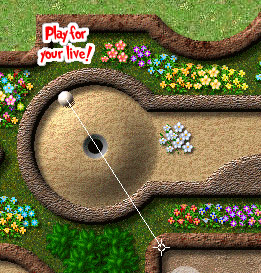
You don’t actually play against anyone. You merely play against yourself and must sink the ball in a certain number of strokes. A hole in one is worth 10 points. Each stroke beyond that is worth progressively fewer points: 5, 3, 2, 1 then 0. After the 0-pointer, you are given one more opportunity where the game warns you that you must play for your, ahem, “live”:


Minigolf -- Play or die

Play or die. The game’s final question was not difficult to answer:


Minigolf -- Do you really want to quit?

Posted in Golf Games Windows Games | Leave a comment

Post navigation

  • Older posts
  • Newer posts

Pages

  • About
  • Master Play List
  • Purchasing These Games
  • The Good

Archives

Proudly powered by WordPress
Theme: Flint by Star Verte LLC